Semi-Synthetic Rayons and Lyocell
Consumers frequently encounter garment labels declaring "100% Bamboo Rayon" or "TENCEL™ Lyocell" and wonder whether they are buying organic plant sheets or pure petroleum synthetics. The truth sits in between: regenerated cellulosics harvest natural plant cellulose from fast-growing wood pulp, but dissolve and re-extrude it through chemical spinneret extrusion.
The Legacy Viscose Process vs. Environmental Toxicity
Patented in 1892 by English chemists Charles Cross and Edward Bevan, traditional viscose rayon converts wood pulp into liquid honey-like xanthate dope by reacting it with caustic soda and carbon disulfide (CS₂). When this dope is pumped into a sulfuric acid regeneration bath, cellulose precipitates into filament threads.
While viscose created the world’s first affordable artificial silk with fluid drape and high gloss, the traditional manufacturing footprint is toxic. Unrecovered carbon disulfide vapors pose severe neurological risks to plant technicians, and uncontrolled effluent acid discharge damaged regional river systems for decades. Furthermore, conventional viscose loses nearly 50% of its tensile strength when wet, making it prone to fiber tears during spin cycles.
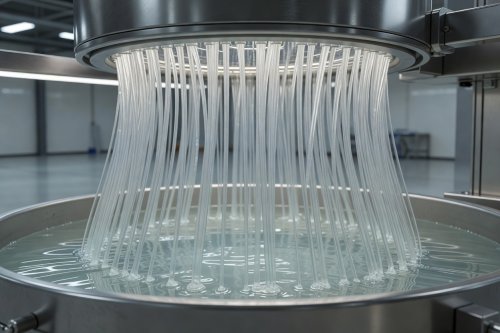
The Closed-Loop Breakthrough: Lyocell (TENCEL™)
In the 1980s, textile scientists developed an organic solvent spinning route that bypassed toxic carbon disulfide entirely. The lyocell process dissolves eucalyptus or beechwood pulp directly in N-methylmorpholine N-oxide (NMMO) and water without chemical derivatization.
In certified closed-loop production facilities, greater than 99.5% of the NMMO solvent is continuously recovered, distilled, and cycled back into subsequent production batches. The resulting lyocell fiber exhibits unique physical properties:
High Wet Tenacity
Unlike traditional viscose, lyocell retains over 85% of its structural tensile strength when soaked in water, preventing laundry wash deformation.
Sub-Micro Nanofibrils
Lyocell fibers consist of uniform bundles of microscopic nanofibrils that manage moisture absorption without skin prickle or surface fuzz.
Closed Thermal Regulation
With an equilibrium moisture regain of roughly 11.5%, lyocell absorbs and transfers human body humidity 50% faster than standard cotton.
The Bamboo Marketing Myth Explained
Apparel marketed as "organic bamboo" is, in almost every commercial case, chemically regenerated viscose. While the original bamboo grass is renewable, the harsh chemical dissolution strips away all natural antibacterial bamboo components. The Federal Trade Commission (FTC) in the United States and international advertising standards actively fine brands for mislabeling viscose as "raw bamboo," requiring garments to be explicitly labeled as "Viscose from Bamboo".
| Regenerated Fiber | Solvent Process | Wet Tenacity (cN/tex) | Environmental Footprint |
|---|---|---|---|
| Viscose Rayon | Carbon Disulfide / H₂SO₄ | 10 – 14 | High chemical discharge risk unless equipped with modern scrubbers. |
| Modal | Modified Viscose (High Wet Modulus) | 18 – 22 | Higher tensile resistance; retains silky hand feel through repeated washes. |
| Lyocell (TENCEL™) | Direct NMMO Solvent Bath | 24 – 30 | Closed-loop >99% solvent recovery; FSC-certified wood pulp sourcing. |
| Cupro (Bemberg) | Cuprammonium Solution | 16 – 20 | Repurposes discarded cotton linter; supreme anti-static lining fabric. |