Wool: The Thermal Crimp
Of all conventional fibers found in contemporary garment racks, natural sheep's wool—specifically high-grade Australian and New Zealand Merino—exhibits the most sophisticated thermodynamic regulation mechanism known to textile engineering. While synthetic polymer extrusions are passive, dead plastic cylinders, wool operates as an active biological heat exchanger.
Microscopic Architecture: The Bilateral Cortex
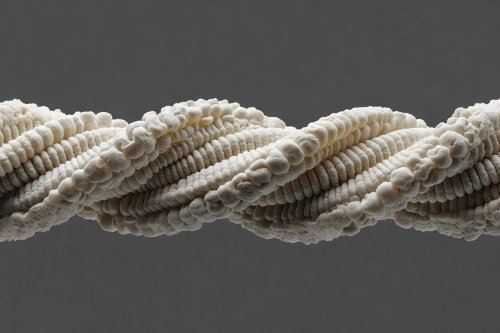
Under an electron microscope, a single wool fiber reveals a natural three-dimensional wave pattern termed the crimp. Premium superfine Merino wool (17.5 to 19.5 microns in diameter) boasts up to 30 crimps per inch. This geometry does not occur by chance: it is driven by two distinct cortical cell populations arranged along opposite sides of the shaft—the orthocortex and the paracortex.
Because orthocortex cells swell to a greater degree in the presence of moisture than paracortex cells, any humidity variation induces differential expansion, perpetually preserving the fiber’s spring-like elasticity. When billions of these microscopic springs are spun into yarn, they create millions of dead-air pockets that trap body heat against conductive thermal loss.
The Heat of Sorption: Physics of Phase Buffering
When water shifts from invisible gas (sweat vapor) to liquid (droplets), an energy transformation occurs. Most athletic apparel users believe perspiration starts as liquid. In truth, human skin continuously emits invisible water vapor (insensible perspiration) at roughly 30 grams per hour at rest.
Wool's inner cortex is loaded with hydrophilic amino acid functional groups (such as serine, threonine, and glutamic acid) that chemically pull moisture vapor molecules into the interior of the fiber via hydrogen bonds. As water vapor is adsorbed into the solid protein structure, kinetic energy is released. This phenomenon is known as the heat of sorption.
When stepping from a warm heated room into freezing exterior temperatures, a 1 kg wool coat can liberate up to 160 kilojoules of heat over several hours simply by absorbing ambient moisture, buffering the wearer against cold shock.
Why Merino Wool Resists Body Odor Indefinitely
Body odor is not generated by sweat itself; it is the waste byproduct of skin microbes (such as Staphylococcus epidermidis and Corynebacterium) metabolizing secreted lipids and amino acids. Polyester actively attracts these oily lipids because petroleum polymers are lipophilic. Once lipids coat synthetic fibers, bacteria colonize the surface and generate short-chain fatty acids (e.g., isovaleric acid) that survive multiple detergent washes.
Wool acts in total opposition: its outer waxy epicuticle is naturally water-repellent, discouraging bacterial colonization on the exterior, while its interior core locks vapor away so sweat never pools into standing liquid. Without liquid water, bacteria cannot proliferate, explaining why Merino garments can be worn for weeks of alpine trekking without developing odor.
| Protein Fiber Variant | Micron Rating | Standard Moisture Regain | Primary Performance Advantage |
|---|---|---|---|
| Merino Wool (Superfine) | 15.0 – 18.5 µm | 15.0% – 18.0% | Extreme skin softness, deep moisture vapor buffering, zero prickle sensation. |
| Traditional Shetland Wool | 28.0 – 34.0 µm | 16.0% – 18.5% | Maximum loft, rugged weather resistance, coarse outer layering protection. |
| Cashmere (Capra Hircus) | 14.0 – 16.0 µm | 14.5% – 17.0% | Unmatched warmth-to-weight ratio; delicate helical fibers require gentle hand care. |
| Mulberry Filament Silk | 10.0 – 13.0 µm | 11.0% | High tensile strength, smooth triangular protein cross-section reflecting natural sheen. |