Synthetics: Tensile Strength
In 1935, Wallace Carothers synthesized Nylon 6,6 in DuPont’s Wilmington research laboratory, fundamentally transforming garment manufacturing. Today, pure synthetic petroleum polymers comprise over 60 million metric tons of annual fabric output. Their primary engineering advantage is undeniable: unrivaled tensile tenacity, chemical inertness, and structural abrasion resistance.
Melt-Spinning and Filament Tenacity
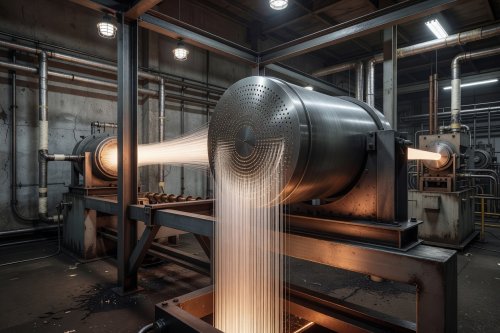
Unlike staple natural fibers that must be twisted together to generate frictional yarn strength, synthetic polymers are continuous monofilaments or multifilaments. Polyethylene terephthalate (PET polyester) resin pellets are dried, melted at roughly 260°C, and pressurized through laser-drilled spinneret plates.
Immediately following extrusion, the still-cooling filaments undergo mechanical cold drawing. Stretching the fibers up to five times their original length aligns the randomly coiled polymer macromolecules along the longitudinal axis of the fiber, establishing crystalline zones held together by van der Waals forces. This alignment gives polyester and nylon their extraordinary tensile rupture resistance (up to 8.5 grams per denier).
The Oleophilic Curse: Why Gym Clothes Never Smell Clean
While apparel brands market polyester as high-performance moisture-wicking gear, the underlying chemistry creates a severe chronic hygiene paradox known as permastink.
Polyester is fundamentally hydrophobic (it repels water, absorbing less than 0.4% moisture) and strongly oleophilic (it attracts non-polar oils). Human perspiration contains both aqueous salts and lipid emulsions (sebum, triglycerides, squalene, and free fatty acids).
When you sweat in a polyester workout shirt, the water evaporates rapidly from the fiber surfaces, leaving the dense lipid molecules behind. These oils migrate into the amorphous microscopic zones of the polyester polymer chains. Standard domestic water-based detergents cannot dissolve these embedded oils at energy-saving wash temperatures (30°C–40°C). Consequently, bacteria like Micrococcus feed continuously on the trapped lipids, re-releasing rancid thioalcohols the instant your body heat warms the fabric.
| Synthetic Polymer | Tensile Tenacity (cN/dtex) | Melting Point | Chemical Vulnerability |
|---|---|---|---|
| Polyester (PET) | 4.5 – 7.5 | 255°C – 265°C | Susceptible to alkaline saponification at boiling temperatures; traps lipids. |
| Nylon 6,6 (Polyamide) | 5.0 – 8.8 | 260°C | Degrades rapidly under concentrated solar UV radiation and acidic bleaches. |
| Polypropylene (PP) | 3.5 – 6.0 | 165°C | Extremely light (floats on water), but vulnerable to oxidation and dryer heat. |
| Elastane / Spandex | 0.6 – 1.2 | 230°C (softens at 150°C) | Hydrolyzes when exposed to body sweat acids, chlorinated pools, and hot tumble dryers. |
Laboratory Tips for De-Odorizing Synthetic Gear
Standard enzymatic detergents are formulated for cellulosic food stains. To strip oleophilic human sebum from polyester athletic wear without destroying elastane stretch yarns:
- Pre-soak in Acetic Acid: Soak garments in a 1:4 distilled white vinegar to water bath for 40 minutes to break mineral-lipid salts.
- Never Use Fabric Softeners: Softeners deposit a silicone wax coating over synthetic threads, permanently sealing odor-causing bacteria inside.
- Oxygen Bleach Sanitization: Use sodium percarbonate in warm wash cycles to chemically oxidize stubborn lipid deposits.